As a country we have a very short memory when it comes to broadband. Anybody in their late 40s or older clearly remembers twenty-five years ago when the predominant form of broadband was dial-up and we were seeing the first DSL and cable modem trials in the market. But I think most people have forgotten about the state of broadband just ten years ago.
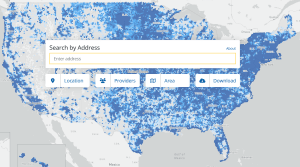
I admit I have the same time bias. I was cleaning out some old bookmarks, and I ran across several articles from ten years that surprised me. The big difference between 2014 and now is broadband speeds. Consider the following map that was published in the Washington Post in early 2014. This shows the average broadband download speed in the U.S. was 18.2 Mbps. The maps shows the parts of the country where speeds were faster or slower than average.

To put these speeds on this map into context, the FCC adopted the updated definition of broadband of 25/3 Mbps in 2015 – updated from 4/1 Mbps. At the time, there were critics who said that 25/3 Mbps was a ridiculously high definition, which can be understood when seeing the large parts of the country on this map where average speeds were under 10 Mbps. The map is an interesting way to see where fiber had already been widely built in 2014, mostly in Verizon FiOS markets in the Northeast and some of the PUDs in Washington. Many other smaller areas had fiber, but are not large enough to be seen on a map at this scale.
In 2014, the national broadband penetration rate was around 80% of households, up from 20% of homes ten years earlier. 2014 is the year when the 18-34 age group spent more time online than watching television (the first this had ever happened for any age group).
Video streaming was becoming a big deal, and Netflix had 48 million customers by the end of 2014. In looking back at blogs and articles, there was widespread complaints about pixelated video streams. Livestreaming was still in its infancy and the Superbowl was livestreamed in 2014 by NBC along with a Verizon mobile app.
Video conferencing was also in its infancy, and before 2014 most videoconferencing required specialized hardware. Skype became the predominant software-based videoconferencing platform, in 2014, but was mostly used for business meetings. Apple users had been using FaceTime for one-on-one video conferencing since 2010.
Ten years ago is also when the cable company first started to lose customers. The year ending March 31, 2013 was the first 12-month period where the big cable companies collectively lost net cable TV customers. At the end of 2013 there were over 8 million homes that had cut the cord, but the cable companies had continued to add new customers to replace those who were leaving.
Apple sold 40% of cellphones in 2014 and Samsung had a 21% market share. BlackBerry still held a 5% market share.
How many of you remember the broadband speed you were buying in 2014? In 2013 I was served by a WISP that delivered about 5 Mbps. In 2014 I moved and subscribed to Comcast, but I can’t recall the speed they provided – my fuzzy memory says it was 30 Mbps.
The bottom line from this look back is a recognition of the extraordinary strides we’ve made with broadband speeds in just ten years. Cable companies now routinely offer gigabit speeds and millions of new fiber passings are being built every year. FWA cellular is bringing pockets of 100+ Mbps all around the country. New fixed wireless radios now have big bandwidth capabilities. I don’t think anybody in 2014 could have predicted where we are today with broadband.