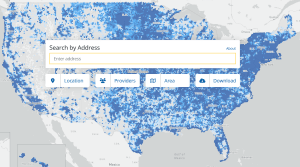
I have been complaining for years about the FCC mapping rule that allow ISPs to claim marketing speeds instead of something closer to actual speeds. That allows ISPs to report speeds that benefit them in some manner rather than being truthful to the public. There have been big consequences as a result of this FCC decision.
Historically, ISPs didn’t pay much attention to the FCC broadband maps. ISPs had to report speeds and coverage to the FCC, but since the maps weren’t used for much more than the FCC’s reports on broadband coverage to Congress, it didn’t matter what speeds ISPs claimed. The FCC certainly didn’t put any effort into verifying the maps, and the FCC got a lot of benefit out of FCC speed exaggerations since it allowed them to tell Congress that a lot more homes had good broadband than actually did.
But suddenly, the maps started to mean something. The USDA used the FCC maps in determining eligible locations for ReConnect grants – and in doing so made some colossal mistakes in denying some grant applications because of map errors. The first massive use of the maps came when the FCC used its own mapping data to determine the areas eligible for the CAF II reverse auction and RDOF. The crappy data in the maps created the disaster or the RDOF serving areas, which in many counties is best compared to Swiss cheese. Since the underlying speed data was bad, RDOF didn’t include Census blocks immediately adjacent to RDOF Census blocks which shared exactly the same ISPs and speed capabilities. If an ISP claimed that one customer in a Census block could receive 25/3 Mbps speeds – regardless of whether that speed was actually available – the Census block was excluded from RDOF.
The FCC had a great chance to fix this faulty rule when it decided to migrate to the new Broadband Data Collection (BDC) system of broadband mapping. Unfortunately, the FCC kept this same old horrible rule that let ISPs claim any marketing speed that benefits them. There is an uncanny number of rural ISPs today that are claiming a speed capability of exactly 100/20 Mbps – the exact speed needed to keep others from getting a BEAD grant in an area.
The FCC recently instituted the new Broadband Labels. ISPs with more than 100,000 customers were required to publish a label by April 10, 2024. All other ISPs have until October 10, 2024. The labels require an ISP to disclose its ‘typical’ download and upload speed and latency for each broadband product. If ISPs participate in the FCC’s Measuring Broadband America (MBA) program, they can disclose the speeds determined in that process. ISPs not participating in that program are supposed to report speeds based on actual internal network testing – not marketing speeds.
With this new rule for the labels, the FCC finally got it right. However, for this to mean anything, the FCC needs to audit the speed test data underlying the claims on the broadband labels. If ISPs know that the FCC is serious about the labels, then ISPs should become more truthful. In looking at the broadband labels published by big ISPs so far, I venture to say that almost none of them are reporting speeds accurately. Some are reporting the identical marketing speeds listed in the FCC maps (such as exactly 100/20 Mbps or exactly 1/1 gigabit). Many big ISPs are claiming on their labels that actual speeds are faster than marketing speeds – something that probably would be a huge surprise t0 most customers.
Now that the labels are in place for the big ISPS and will soon be in place for other ISPs, the FCC has a perfect opportunity to get this right in the labels and the maps. ISPs should be required to report the same speeds for the FCC maps that it puts on the broadband labels. The speeds on the labels should be based on actual speed testing and not on a speed cooked up by a marketing or regulatory department. ISPs will only be serious about getting this right if the FCC periodically audits ISPs and asks to see the underlying speed testing data – and fines ISPs that have exaggerated speeds.
I don’t have much hope that the FCC will do the right thing. If rural ISPs suddenly start to tell the truth about speeds on the FCC maps, we’d instantly see all of the places that the BEAD grants will not be covering. I’m sure the FCC understands this, and it has never wanted to see a story from ISPs that shows a greater number of unserved locations.