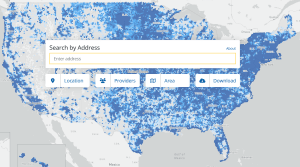
Mike Conlow was amazingly quick as usual and assembled a quick comparison of the new fourth version of the FCC broadband map to the previous third version. The new map reflects data as of December 2023.
The big change since the third version of the map is a big decrease in unserved and underserved locations. Mike’s count shows that total unserved and underserved locations on the map are now 8.8 million, down from 10.1 million. If true, this is a huge change in the rural broadband landscape.
There are a lot of factors that could impact a change of this magnitude. Before discussing these issues, here are the net changes between the third and fourth FCC broadband maps:
- Total passings increased by 388,222.
- Served passings increased by 1,644,756.
- Underserved passings (25/3 Mbps to 100/10 Mbps) decreased by 157,132.
- Unserved passings (under 25/3 Mbps) decreased by 1,099,402.
The change varies widely by state. For example, Nevada and North Dakota show over a 40% drop in unserved locations, while nine states saw a drop of unserved locations under 5%. Arizona saw an increase of 8,925 unserved locations. The biggest drops in unserved locations were in Texas (-143,669), Missouri (-59,576), Michigan (-59,384), and California (-58,957).
The big question that must be asked is if these changes make any sense. Let’s start with a list of reasons why passings would change between the third to the fourth FCC maps.
Total passings should increase to reflect new homes being built. I’ve always wondered how CostQwest (the keeper of the FCC mapping fabric) is able to keep up with new home construction by address.
Total passings for a state can also increase or decrease due to corrections in the mapping fabric. In my own investigations, I’ve encountered a lot of homes that are not in the mapping fabric, locations in the fabric where there is no real-world building, and locations like barns that are not an addressable broadband location. I would hope that CostQuest is fixing these over time as they find better data sources. Changes can also come from individual challenges to the FCC maps for folks who complain their home isn’t listed in the fabric.
The biggest change to unserved and underserved passings probably comes directly from ISPs that have changed the way they are reporting in the FCC map. There are a number of reasons why an ISP might change its FCC reporting.
- An ISP might have built new infrastructure and is properly reporting locations that now have a new source of broadband. New broadband construction might have been funded by state and local grants, RDOF, ReConnect, or other sources. Some ISPs are self-funding broadband expansion.
- An ISP might have upgraded technology. A WISP might have upgraded radios and speeds. A cable company might have upgraded from DOCSIS 2.0 or 3.0
- ISPs might have arbitrarily reported faster speeds. In looking at broadband mapping data in different places around the country, I’ve encountered a suspiciously large number of places where an ISP claims exactly 100/20 Mbps capability. That’s a speed that categorizes a location as served and makes it ineligible for BEAD grants and many other grants. I’ve seen the 100/20 Mbps speed claimed for DSL, fixed wireless, and cellular fixed wireless.
Recall that the FCC mapping rules only require ISPs to report marketing broadband speeds. If an ISP markets to customers with speeds ‘up to 100/20 Mbps’ it is not breaking FCC rules to make that claim in the maps – even if it only delivers 30/5 Mbps to a location. This FCC rule to allow marketing speeds instead of some approximation of actual speeds has made a travesty out of the maps.
Is it believable that 1.3 million fewer unserved locations in the country got upgraded to faster technology in a six-month period? Almost by definition, most of the unserved and underserved locations are rural. While there is a lot of fiber construction underway due to broadband grants, it’s hard to picture that grants covered that many new rural locations during a six-month period. Consider the amount of investment that would have required. If the average cost per upgrade was $6,000, this would have meant completing $7.8 billion of construction in the second half of last year in rural areas. It’s hard to think even half of that was spent in a six month period.
That is not a believable number. It seems a lot more likely that ISPs are changing the areas they claim to cover and the speeds they are claiming to provide.
Seeing these big mapping swings while States are trying to launch the BEAD grants is one more sign that BEAD will be a mess. Some states have already gone through the early stages of the BEAD map challenge, and these new changes will not have been reviewed or challenged by anybody. It seems more likely with every big mapping swing that more places will fall through the crack and that deserving locations will get skipped by BEAD.