
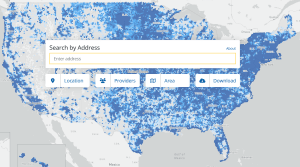
 There is one nuance of the FCC maps that doesn’t seem to be talked about. ISPS are only supposed to show coverage on the FCC maps for locations where they are able to serve within ten business days of a customer’s request for service. Any ISP that is claiming areas it won’t serve that quickly is exaggerating its coverage on the FCC maps. That can have real-life consequences.
This issue can apply to ISPs using many different technologies and situations:
- I moved to a home in Florida and was told by Comcast that I couldn’t get broadband without a site survey because they didn’t know if the network was available, although all of my neighbors had Comcast, and there was a pedestal in my yard. It took me 45 days to convince Comcast to do a site survey and then several more weeks to schedule the drop.
- Many fiber builders routinely take 30 days or more to schedule drop construction – following the mapping rules would imply only showing existing customers on the FCC map. Many fiber overbuilders won’t build a drop over some set length unless the customer pays the extra cost. Can an ISP claim an area as served when a customer will have to agree to pay $1,000 to get connected?
- In looking at detailed mapping data, I find apartment building claimed within the coverage of large cable companies that don’t have cable broadband. It’s almost inconceivable that any ISP could bring service to a large apartment building within ten days of a request. There are dozens of issues involved with bringing broadband to MDUs.
- WISPs routinely tell prospective customers that they don’t know if they can serve them until they conduct a site survey. It often turns out that they can’t serve some homes without taking extra steps like constructing a tall pole to receive the signal or cutting down trees – but often, some locations can’t served. There are some neighborhoods where a WISP can’t reach most homes. I’ve talked to several WISPs who are clueless about how to accurately report to the FCC.
- Starlink shows widespread coverage in the FCC maps, although there are now many neighborhoods that are considered as saturated and where the company won’t take any new customers.
- Many of my readers know Chris Mitchell. The FCC map for his home deep inside St. Paul, Minnesota showed the availability of gigabit wireless from a WISP. Upon inquiry, the WISP said it was willing to serve him but would have to build fiber first to be able to deploy the needed radios. It’s fairly clear that this particular WISP is using the FCC maps as advertising to let folks know it is in the area, and it had greatly exaggerated its coverage area by ignoring the 10-day rule.
There are real-life consequences for areas that are misclassified on the FCC maps. Consider the pockets of unserved areas inside cities. We worked with an urban area recently where we identified nearly 200 such unserved pockets. If those pockets were identified correctly on the FCC maps, then an ISP could ask for BEAD or other grant funding to extend network into these small areas. But if they are claimed as served, then it would be an uphill battle to get grant funding.
In rural areas, any ISP that offers speeds greater than 100/20 Mbps is effectively locking down areas that it claims to serve – and in doing so, is stopping grant money from funding unserved areas. I can’t imagine any easy way to estimate the overall impact of areas that are overclaimed because of ISPs ignoring the 10-day rule – but it’s not hard to imagine that this could represent an additional 5% – 10% of unserved places in rural areas that are incorrectly identified as served. It’s hard to even imagine the extent of the problem in urban areas.